
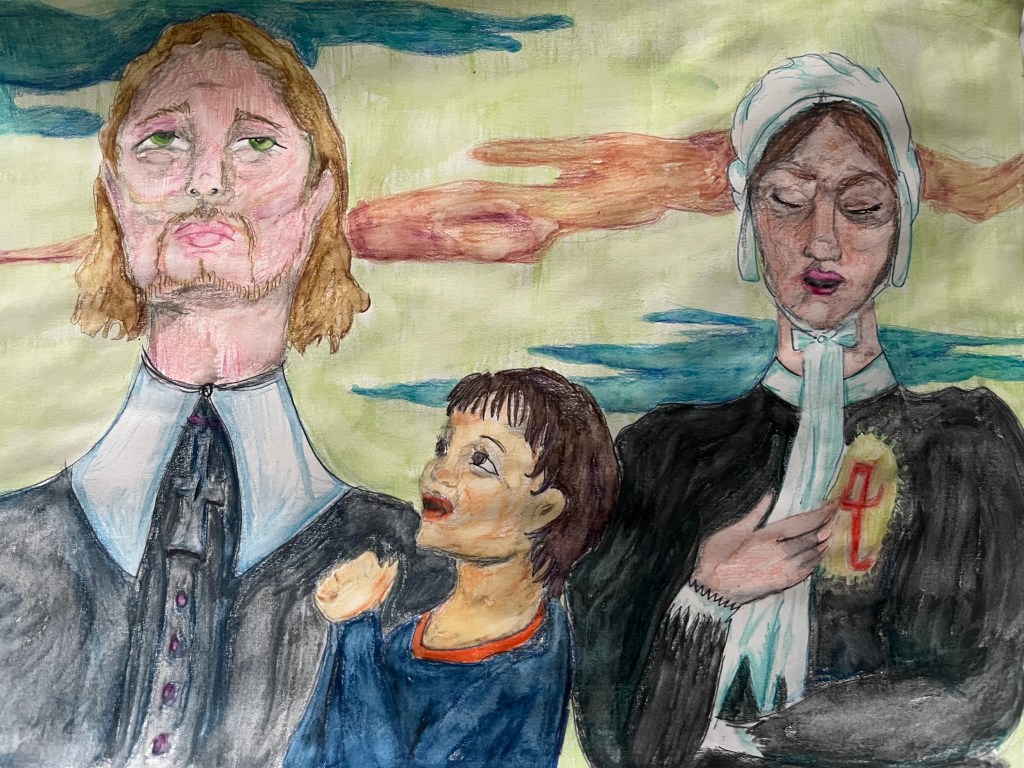
“And there stood the minister, with his hand over his heart; and Hester Prynne, with the embroidered letter glimmering on her bosom; and little Pearl, herself a symbol, and the connecting link between those two. They stood in the noon of that strange and solemn splendor, as if it were the light that is to reveal all secrets, and the daybreak that shall unite all who belong to one another.
There was witchcraft in little Pearl’s eyes, and her face, as she glanced upward at the minister, wore that naughty smile which made its expression frequently so elvish. She withdrew her hand from Mr. Dimmesdale’s, and pointed across the street. But he clasped both his hands over his breast, and cast his eyes towards the zenith.
Nothing was more common, in those days, than to interpret all meteoric appearances, and other natural phenomena, that occurred with less regularity than the rise and set of sun and moon, as so many revelations from a supernatural source. Thus, a blazing spear, a sword of flame, a bow, or a sheaf of arrows, seen in the midnight sky, prefigured Indian warfare. Pestilence was known to have been foreboded by a shower of crimson light. We doubt whether any marked event, for good or evil, ever befell New England, from its settlement down to Revolutionary times, of which the inhabitants had not been previously warned by some spectacle of this nature. Not seldom, it had been seen by multitudes. Oftener, however, its credibility rested on the faith of some lonely eye-witness, who beheld the wonder through the colored, magnifying, and distorting medium of his imagination, and shaped it more distinctly in his after-thought. It was, indeed, a majestic idea, that the destiny of nations should be revealed, in these awful hieroglyphics, on the cope of heaven. A scroll so wide might not be deemed too expansive for Providence to write a people’s doom upon. The belief was a favorite one with our forefathers, as betokening that their infant commonwealth was under a celestial guardianship of peculiar intimacy and strictness. But what shall we say, when an individual discovers a revelation addressed to himself alone, on the same vast sheet of record! In such a case, it could only be the symptom of a highly disordered mental state, when a man, rendered morbidly self-contemplative by long, intense, and secret pain, had extended his egotism over the whole expanse of nature, until the firmament itself should appear no more than a fitting page for his soul’s history and fate!
We impute it, therefore, solely to the disease in his own eye and heart, that the minister, looking upward to the zenith, beheld there the appearance of an immense letter,—the letter A,—marked out in lines of dull red light. Not but the meteor may have shown itself at that point, burning duskily through a veil of cloud; but with no such shape as his guilty imagination gave it; or, at least, with so little definiteness, that another’s guilt might have seen another symbol in it.”
Excerpt From
The Scarlet Letter
Nathaniel Hawthorne
This material may be protected by copyright
I’ve been reading The Scarlet Letter by Nathaniel Hawthorne, a literary masterpiece themed on morality, guilt, legalism, compassion and forgiveness.
I am not done reading yet, but I am already struck by several themes presented by the author in this novel of redemption:
- The scapegoat is a woman. While two people (a man and a woman) are involved in the sin of adultery, the only one carrying the weight of public humiliation, as well as the duty to redeem humanity as a whole, is a woman. The moral court of men claims that they want to impart an exemplary punishment to warn against the violation of a sacred bond, set forth by God himself; but only the woman ends up being ostracized and having to display the mark of her moral fall on her clothes. Meanwhile, the man involved in the misdoing –potentially, an even more depraved one, as he betrays his vow of celibacy as a minister of God– can atone for his sin in the secrecy of his room, self-administering and misdirecting the punishment through the substitute of corporal torture. For a long part of the narration, he doesn’t share equally the consequences of his own sin, and he doesn’t engage in a journey of moral elevation by facing the impact of his actions.
It’s not surprising, then, that the product of the sinning couple is a baby girl, as if God’s punishment would keep manifesting in the sex of the child. - The fear of a fall from grace shows up in a series of obsessive superstitions. Hester Prynne, the sinner, has already lost God’s mercy, so her whole existence becomes rooted in action and labour.
As spiritual superiority seems inaccessible to her, she gives meaning to her life by serving others: she tailors clothes, embroiders vestments, watches over the ill and sustains the poor.
Meanwhile, the rest of the population, who attains moral superiority by not being caught while sinning, lives in the fear of becoming like Hester Prynne. The author shows them as being stuck in their head, hiding behind shut blinds, praying, and falling prey to endless superstition around witchcraft and demonic presences. - The tribunal of mankind judges a book by its cover. No one suspects that a sinner could hide behind the pious smile and the affected words of Dimmesdale, but they’re quick to attribute any sort of dissoluteness to Hester Prynne, a poor woman, a seductress and mother of an unusual child.
The folk in The Scarlet Letter embodies the all-too-human fallacy of trusting in the existence of a “perfect victim”, worthy of compassion and support, as well as the prototype of “man of morality”, preferably an institutional figure already privileged with power and thus immune to any fault.
The short-sightedness in the interpretation that the folk gives to Hester Prynne’s affair is perfectly complemented, and amplified, by the inner torment that affects Dimmesdale.
My drawing is inspired by the scene in which Dimmesdale visits the trial’s scaffold at night, raptured by an unconfessed desire to expiate his guilt by vicariously re-living the condemnation of his lover, Hester Prynne.
 Eva Casini